

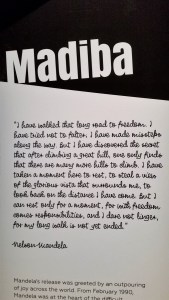
Mandela My Life: The Official Exhibition opened on Saturday, 22nd September 2018 at Melbourne Museum, and I didn’t hesitate to buy myself a ticket. He would’ve been 100 this year.
As it tours internationally, in celebration of the Nelson Mandela Centenary, the exhibition is showcasing a selection of items from his vast Johannesburg collection. It’s a reminder of the man who changed history, both in his own country and around the globe.
Laughter, joy, tears. I experienced all of these as I browsed the documents, artefacts and items of personal memorabilia on display. Captivated by the soundbites and scattered film footage, I was most affected by the moments reflecting his inimitable character.
I was moved by the sight of his inked handprints on the page of a book, under which he had written, My Hands, NMandela. There was a childlike exuberance about it. The photograph of him cleaning his shoes onboard the presidential jet, the reference to him rising before dawn and making his own bed, even when staying in a hotel. These things shine a light on the guiding principles and inherent nature of a determined and disciplined man. His ability to survive the deprivations of prison for 27 years came from this discipline, together with his ability to reframe his situation, to consider the usefulness of the solitude, to view it as a time to reflect, read and think. You know you are beholding greatness when you see a man who can rise above misery and observe only the lightness of the horizon.
Madiba – a title of respect derived from his Xhosa clan name – Tata, Father. All of these names seem more suitable than Nelson, given to him, I learn, by his teacher when he started school. Hearing him describe his childhood, listening to his voice narrating so many aspects of his own story is a constant joy as I wander through time and history, his tone both thoughtful and compelling, his words well chosen. He is spectacularly present here. It’s difficult to believe he is gone.
There’s a sense of intimacy, easily conjured, by a man whose image has featured so frequently across the decades. Throughout my childhood our television showed the regular protests across the world, there were songs written, placards were held aloft in student marches. I remember all the cries to Free Nelson Mandela!
One of the great moments in history was his release in 1990. I remember watching the television footage, seeing him walk through the amassed crowds that had been proliferating, waiting to welcome this first moment of freedom. It was exhilarating. It seemed inconceivable. He had finally achieved the impossible. The world had been changed, and he was back in it.
I can’t think of a better or more dignified example of persistence in the face of adversity than Mandela. Knowing that he lived a further 23 years after his release brings an added sense of justice. Becoming the South African President in 1994, serving for six years, meeting world leaders and travelling across the world? Well he had 27 years to construct that reality. He must have cultivated great patience.
At the tail end of the exhibition, facing two chairs and a table which used to occupy Mandela’s office, there’s a final touchscreen. This is not to be missed. On it you’ll see a few film snippets, the last being his retirement speech. It’s the one in which he thanks The Press then goes on to display his characteristic humility, wit and humour. I smiled through its entirety. It was the essence of Madiba.
Also unmissable are the 16 paintings by John Meyer, Going Home unquestionably being my favourite. It depicts Mandela as an old man, returning to his beloved Qunu. Evocative and soulful, I found myself falling into the landscape, shadowing this elderly figure, wanting to follow him, even as his back is turned.
Having climbed a great hill, he said, after his liberation, one only finds that there are many more hills to climb. Nevertheless, he admits to have taken a moment here to rest, to steal a view of the glorious vista that surrounds me, to look back on the distance I have come. When he was released from prison he knew he had come a long way. Yet, despite his newly acquired freedom he knew, my long walk is not yet ended. There would be no resting on laurels, or time for self-congratulation about successes. It would be a couple of decades before he would finally conclude his walk. I wonder if he imagined it would take him so far?
It seems fitting that his longevity allowed him to benefit from the changes he had instigated so many decades earlier; and while we’ve noticed his absence in the last few years, we also have inumerable memories.
Looking at that imagined homecoming in Meyer’s painting, as Mandela walks a meandering path towards the distant hills, it is clear that he did enough. His achievements outlive him and continue to inspire. His long walk may have ended, but it is up to us to follow in his footsteps, and to continue his legacy.
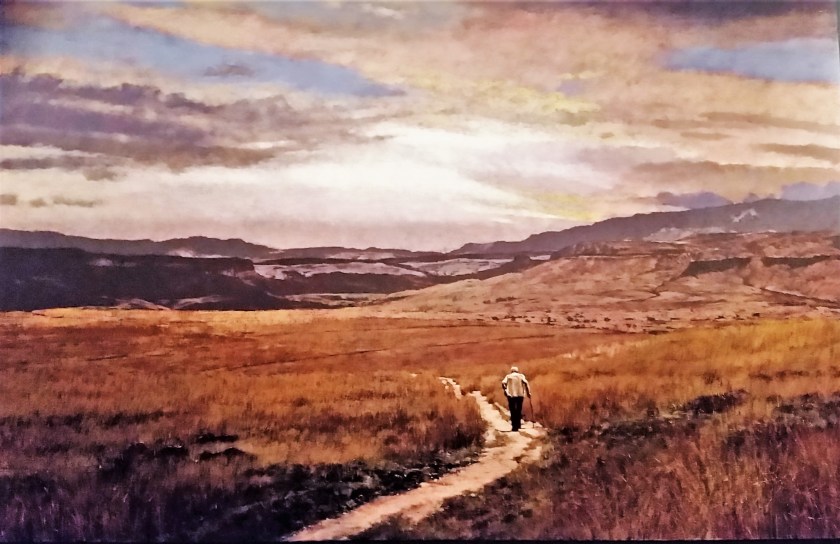
Going Home by John Meyer
(Also, see: https://en.wikipedia.org/wiki/Free_Nelson_Mandela)
Photographs on Facebook page
 Angela J Dawson